The beach
Nissi Beach: The Complete Practical Guide
Last updated 7 September 2026
Nissi Beach is the most famous beach in Cyprus's Famagusta district: a crescent of pale sand, shallow turquoise water, and a sandbar you can wade across to a small islet. It's also a beach with two price lists, parking that gets tight by mid-morning in peak summer, and a very different character at 7:30 in the morning than at 3 in the afternoon. This guide answers the practical questions with current 2026 figures, with verification dates noted where relevant.
Quick answers
Entry is free. Sunbeds cost €3.50 at the municipal section or €8–12 at the beach-bar sections. The gated car park charges €3 up to 2 hours or €4 for 2–24 hours, first 15 minutes free (July 2026); in peak season spaces can be tight by mid-morning. The sandbar crossing is best before 9am at low tide. Bus 201 stops at the beach; a taxi from the town centre is €5–8.
Is there an entrance fee?
No. All beaches in Cyprus are public by law, and at least half of every organised beach must remain free of commercial sunbeds so you can lay your own towel at no cost. At Nissi, the towel-friendly open sand is mostly at the western end and in the strip between the sunbed rows and the water. You only pay for extras: sunbeds, umbrellas, water sports, food and drink.
Sunbed and umbrella prices in 2026: the €3.50 cap vs the €12 reality
This is the question that confuses everyone, because two pricing regimes operate on the same sand — and most guides won't tell you that.
In early 2026, Cyprus's Central Committee of Beaches raised the legal maximum for municipally licensed sunbeds for the first time in nearly two decades: from €2.50 to €3.50 per sunbed and €3.00 per umbrella. Ayia Napa municipality applies the new ceiling, so a municipal set of two beds and an umbrella costs €10.00. You should get a printed municipal receipt — ask for one.
But the cap only binds the municipal concessions. Private operators and the beach bars/hotels fronting the sand set their own prices, and at Nissi Beach those typically run €8–12 per sunbed, plus €3–5 for an umbrella — meaning a beach-bar set can cost €20–25+. That's legal; it's a different licence. What you're paying extra for is the location in front of the bar, waiter service to your sunbed, and sometimes a minimum-spend arrangement instead of a flat fee.
| What | Where | Typical 2026 price |
|---|---|---|
| Sunbed (municipal section) | Capped by law | €3.50 |
| Umbrella (municipal section) | Capped by law | €3.00 |
| Sunbed (beach bar / private section) | Operator-set | €8–12 |
| Umbrella (beach bar section) | Operator-set | €3–5 |
| Your own towel on open sand | At least 50% of the beach | Free |
Prices verified June 2026; the municipal cap is set annually — we update this table every May.
How to pay €10 instead of €25: ask the attendant whether the section is municipal before you sit down, and request the receipt. Note that since 2025 several Famagusta-area municipalities strictly enforce a no-reservation rule — a towel left on a sunbed to "claim" it without paying can be removed by staff.
Food and drink prices on the beach
At the beach bars, budget roughly €8–12 for a cocktail, €4–6 for a beer, and €8–15 for a light meal. A 1.5L bottle of water that costs €2–3 at the supermarkets on Nissi Avenue runs several times that on the sand — bringing your own water is normal and nobody minds. For a sit-down meal a few minutes from the beach, Petra Snack Bar (budget, family-run), Zaatar (Lebanese/Syrian) and the Glasshouse at Adams Beach Hotel cover three price brackets.
Parking: the gated car park, €3–4
The main gated car park at Nissi Beach charges, as of July 2026: first 15 minutes free, €3 up to 2 hours, €4 for 2–24 hours. A ticket is valid once — leaving and re-entering means paying again.
In peak season, spaces can be tight by mid-morning. When we checked on a July 2026 afternoon, spaces were available again.
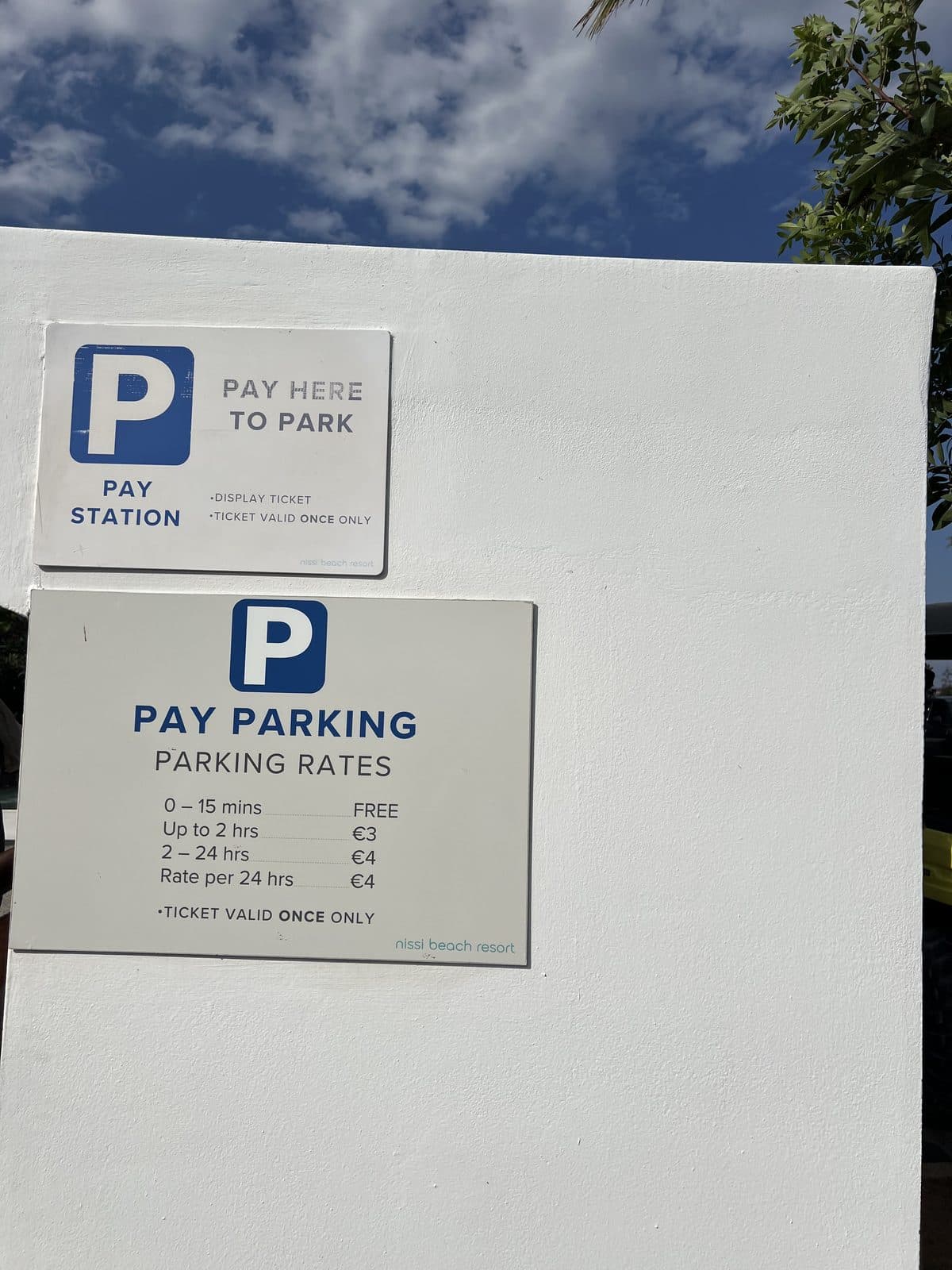
No car at all is still the simplest answer: a taxi from the town centre is a fixed €5–8 each way, or take bus 201 (below).
The sandbar and the islet
The signature experience: a natural sandbar links the beach to Nissi islet, and when conditions allow you can wade across in knee-to-waist-deep water. Three things determine whether you get the postcard version:
- Time of day. Between roughly 7:00 and 9:00 in the morning the bay is typically mirror-calm and the crossing is at its clearest — this is also when the photos without 200 strangers in them get taken.
- Tide and wind. The Mediterranean's tidal range is small, but a fresh onshore wind pushes water over the bar and stirs the sand. Calm days, low water = the clean white walkway.
- The channel. There's a deeper channel beside the bar. Confident swimmers cross it without thinking; keep young children on the bar itself.
Water shoes help on the islet's rocks, and the rocky fringe around the islet is also the best snorkelling at Nissi — bring your own mask and it's free.
Watch for rocky patches. Most of Nissi's main shallows are sandy, but there are visible rocky sections, particularly toward the central/western side and around the islet. On choppy days, avoid standing or swimming directly over them — a wave can push you into the rocks and cause cuts or bruising. Use a clearly sandy entry where possible.
Best time to avoid the crowds
- July–August: arrive before 09:00 if you want a quieter beach and a good choice of sunbeds; around 08:00–08:30 is better. By mid-morning Nissi can already be very busy.
- June and September: mornings are still the best time for lower crowds, but there is usually more flexibility than in July–August.
- May, October and winter: crowd pressure is much lower, so arriving very early matters far less. From November to March the beach is nearly empty — see Nissi Beach in winter.
Families and children
Nissi is one of the best family beaches in Cyprus for a simple reason: the water shelves very gently, so small children can paddle a long way out in shallow water. Mornings are generally calmer, and in July–August arriving early makes it easier to find a comfortable spot. The one genuine caution is the deeper channel by the sandbar. For toddlers, nearby Makronissos Beach (two stops further on bus 201) is shallower, quieter and has the same sand.
Facilities relevant to families: toilets, showers, changing rooms, and lifeguards on duty through the main season (roughly April–October).
Water sports (summer only)
In season, operators on the beach offer roughly:
| Activity | Typical 2026 price |
|---|---|
| Parasailing | €60–70 |
| Jet ski (15 min) | €30–40 |
| Banana boat / ringos | €10–15 pp |
| Pedalo | €15/hr |
| SUP | €10–15/hr |
Age and licence limits apply for jet skis — operators check. Everything above is summer-only; by November the concessions are packed away. The nearest cool-season alternative in the water is the MUSAN underwater sculpture museum off Pernera Beach: the sculptures sit on the seabed all year, but getting to them depends on dive-centre operation, sea conditions and your own experience and kit — check current availability before you count on it.
Showers, toilets, lockers
Nissi has the full Blue Flag set: freshwater showers, toilets, changing rooms, and lockers for valuables in season. Lifeguards are posted during the main season. Facilities are concentrated at the central/eastern section near the bars.
An honest note on seaweed
A few times a year, wind and currents push posidonia sea-grass onto the shoreline and the water's edge looks brown rather than turquoise for a day or two. It's natural, harmless, and cleared quickly at an organised beach like Nissi — but if you arrive on one of those mornings, the beach won't match the drone photos. It passes.
How to get to Nissi Beach
- From Ayia Napa town centre: ~3 km — a 35–40 minute flat walk, a €5–8 taxi, or the bus.
- By bus: route 201 (West Circle Line) runs from Ayia Napa Central Bus Station along Nissi Avenue and stops directly at Nissi Beach (also serving MUSAN, Vathia Gonia, Landa, Makronissos and the Marina). Routes 101/102 run along Nissi Avenue toward Cape Greco and Protaras — useful if you're staying on the avenue, but it's the 201 that goes down to the beach itself. Fares as of June 2026: €2.00 daytime single, €3.00 at night, €6.00 one-day ticket — cash on the bus, so carry change. Frequencies drop sharply in winter, so check the current OSEA timetable off-season.
- From Larnaca Airport: ~45–55 minutes by car, taxi or transfer. There is no regular public bus direct from the airport to Ayia Napa — the budget route is a Cyprus Public Transport bus from Larnaca Airport into Larnaca city (€2.70 cash daytime from 3 August 2026; route 425 is the current airport–city service, but check the current CPT timetable), then OSEA route 711 (€2.00 daytime) or the separate InterCity Buses coach (€5.00 one-way, checked September 2026) to Ayia Napa, then the 201 or a taxi down to the beach. Full options in the practical guide.
Nissi Beach in winter
The beach stays open, free and genuinely beautiful from December to March — empty sand, low golden light, sea at 16–18°C. Swimmable for the hardy (the local winter-swimming crowd does it daily), a walking beach for everyone else. The bars, sunbeds and water sports are shut. If that sounds like your kind of trip, start with Ayia Napa in winter and winter long stays.
Frequently asked questions
- Is Nissi Beach free?
- Yes — it's a public beach with free access, and by law at least half the sand must stay free of commercial sunbeds for towels. You only pay for sunbeds, water sports, food and drink.
- How much are sunbeds at Nissi Beach in 2026?
- €3.50 per sunbed and €3.00 per umbrella at the municipally licensed section (the legal cap, raised from €2.50 in 2026 — set of two beds + umbrella = €10). Beach-bar and private sections set their own prices, typically €8–12 per sunbed. Ask which section you're in and request a receipt.
- Is parking at Nissi Beach free?
- The main gated car park at Nissi Beach charges €3 up to 2 hours and €4 for 2–24 hours, with the first 15 minutes free; a ticket is valid once, so leaving and re-entering means paying again (July 2026). In peak season spaces can be tight by mid-morning, though when we checked on a July 2026 afternoon spaces were available again. Alternatives: a €5–8 taxi from town, or bus 201.
- Can you walk to the islet?
- Usually, yes — a shallow sandbar connects the beach to Nissi islet. It's clearest on calm mornings before ~9:00. There's a deeper channel beside the bar, so watch children, and water shoes help on the islet's rocks.
- Is Nissi Beach good for kids?
- Yes — gently shelving shallow water, lifeguards in season, and calmer mornings. The main shallows are sandy, but watch for visible rocky patches, especially when there are waves. For toddlers, Makronissos two bus stops away is even gentler.
- Which bus goes to Nissi Beach?
- Route 201 (Ayia Napa West Circle Line) from the Central Bus Station stops at Nissi Beach. The 101/102 run along Nissi Avenue toward Cape Greco/Protaras but don't loop down to the beach. Cash fare to the driver; reduced winter frequency.
- When is the best time to visit Nissi Beach?
- To avoid crowds, arrive before 09:00 in July–August; mornings are still best in June and September. May and October are quieter, while December–March is best for an almost empty beach and walking weather.